HVOF Spraying
The coatings sprayed with HVOF are characterized by a low porosity and a high bonding strength.
Highlight
Benefits
- Fine micro structure
- Very dense and low porous coatings
- High bond strength
- Finishes to an extremely smooth surface
- Optimal micro hardness
- Excellent corrosion properties
- Excellent for hard metal (carbide coatings)
- Low degree of oxidation
Applications
- Sealing moving surfaces to prevent seals from leaking
- Improvement of wear resistance and chemical protection of ball valves
- Protection of hydraulic piston rods against sea-water environment in the offshore industry
- Repairs and dimension corrections of worn drive shafts and bearing seatings
- Substrate for Thermal Barrier Coatings (TBCs)
- Cavitation protection in hydro electric power stations
- Protection of pump casings and impellers against chemical corrosion
Overview
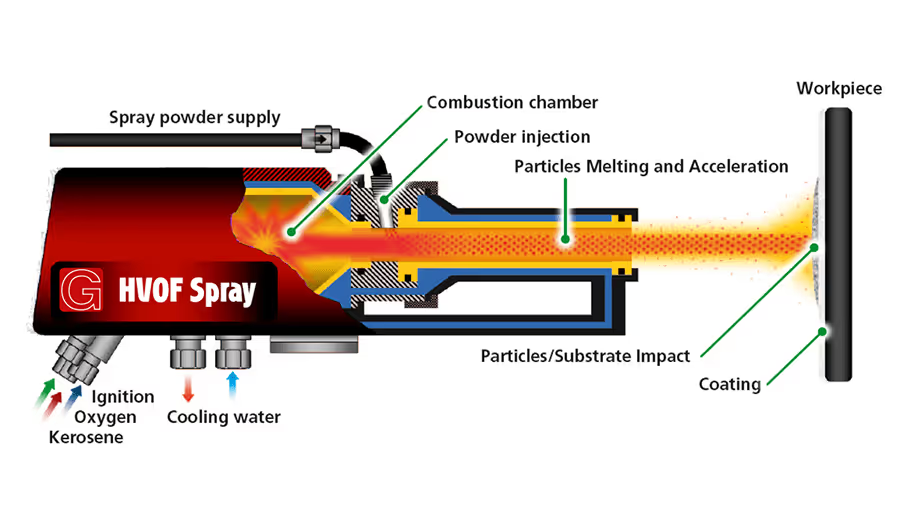
When HVOF (High Velocity Oxygen Fuel) spraying fuel and oxygen are ignited. The flow of gas expands through a special nozzle and reaches a speed of more than 1,500 m/s. The coating powder is injected axially in the gas flow reaching extremely high speeds up to 800 m/s. The coatings sprayed with HVOF are characterized by a low porosity and a high bonding strength.
In the recently developed high-pressure, high-speed process (HP-HVOF, High Pressure - High Velocity Oxygen Fuel) the mixture of fuel and oxygen is additionally accelerated through a special nozzle. The gas flow reaches speeds up to 2,200 m/sec. Depending on the injection type of the coating powder, axially or radially, the powder has an extremely high speed up to 1,100m/sec. The coatings created in this way are characterized by an even lower porosity and higher bonding strength when compared with the first generation of HVOF systems. Depending on the selected fuel, the flame temperature ranges from 3,000°C to 4,000°C.
Typical coatings
- Cermets, carbides (tungsten carbide, chromium carbide)
- Super alloys based on iron, nickel, and/or cobalt (Stellite, Triballoy, Inconel, Hastelloy, etc.)
- Hard Chrome Replacement
- MCrAlYs bond coatings under TBCs (Thermal Barrier Coatings)
HVOF Spraying
is used to apply
TOPCOAT+
Enhanced ceramic coating with superior corrosion and chemical resistance.
TOPCOAT ULTRA+
Ultra-dense ceramic coating with unbeatable wear, chemical and corrosion resistance.
TOPCOAT CCR
High-density chromium carbide coating as a 1:1 galvanic (nickel-)chromium replacement.
TOPCOAT CCR+
Enhanced galvanic (nickel-)chromium replacement with superior corrosion and wear resistance.
TOPCOAT WCR
Tribologically equivalent to electrolytic (nickel-)chromium with better corrosion and chemical resistance.
TOPCOAT WCR+
Enhanced tungsten carbide coating with UHCR bond layer, resulting in 3x the wear resistance of hard chrome.
TOPCOAT 177
Ultra-high corrosion resistant nickel-based superalloy bond layer for severe corrosion and chemical environments.
TOPCOAT 107
Nickel–chrome replacement with superior wear and corrosion resistance.
TOPCOAT 107+
Advanced nickel/carbide system for maximum durability in the world’s harshest environments — above water and underwater.
Request we contact you
Request Quotation
Fill out the form to request a quote.
Request a quote