4 min
HVOF vs hard chrome plating, comparing wear resistance, corrosion protection and hardness
Once the process differences are clear, the next question is how the two coatings actually perform against each other. The comparison comes down to three properties, wear resistance, corrosion resistance, and hardness, and the honest answer is that thermal spray does not automatically win on every count for every application. A fair comparison has to say so, as part of the wider case for [replacing hard chrome plating](Pillar page).
Wear resistance: HVOF versus hard chromium plating
Hardness is the starting point for wear resistance, though not the whole story. Standard chrome plating measures around 650 to 700 HV (Vickers hardness), while hard chrome variants, produced using chromium-6 rather than the less hazardous chromium-3, reach roughly 1,000HV.
“Chrome-6 was the standard for so long because it’s harder than chrome-3 and it bonds better to the base material. That’s exactly why it became so widely used, even though it’s also the version that’s turned out to be hazardous to work with.”
Mario van Helmond, CEO Griekspoor Thermal Coatings
That trade-off, between performance and safety, is at the heart of why the industry has spent the past decade looking for a genuine substitute rather than simply switching to chromium-3 and accepting a softer coating. Thermal spray coatings span 900 to 1,500 HV depending on the variant chosen, comfortably overlapping and often exceeding hard chrome’s hardness without the same processing hazards.
Hardness alone doesn’t determine wear resistance, though. A coating that is hard but brittle can chip or spall under impact loading, while a coating that is tough but soft can deform and wear away gradually. The most wear-resistant coatings combine both properties,which is why Griekspoor’s TOPCOAT 107+ variant, discussed in the previous article, performs above what its hardness number alone would predict.
Corrosion resistance: (nickel)chrome plating vs thermal spray coatings
(Nickel) chrome plating has an inherent structural weakness that has nothing to do with how carefully it’s applied. The electroplating process deposits chromium in a way that leaves microscopic cracks throughout the layer, a by product of internal stress that builds up as the metal crystallises out of solution.
“Chrome plating is never fully solid. The plating process leaves tiny cracks in the layer, and under the wrong conditions, that’s exactly where corrosion starts.”
Mario van Helmond, CEO Griekspoor Thermal Coatings
Under stable, dry conditions those cracks rarely cause problems. Under cyclic loading, temperature swings, or prolonged exposure to moisture, they widen gradually and give corrosive agents a direct path down to the base material, undermining the coating from beneath rather than wearing through it from the top.
Thermal spray coatings don’t share this structural limitation in the same way, and because they aren’t restricted to a single material, they can be formulated as an alloy specifically chosen for corrosion resistance in the target environment, rather than relying on the properties of chromium alone. That flexibility is where a concrete example is useful: an industrial seal manufacturer began developing a joint testing programme after its own customers started asking for chromium-6-free alternatives. Test rods at several roughness levels were evaluated for wear and leakage over several years, leading to jointly established roughness specifications across an entire seal range. One result, in the dairy and packaging industry, involved a seal cycling ten times per second that previously needed replacing every one to two weeks; switching to a thermal spray coating extended its service life roughly tenfold.
Hardness and fatigue life compared to electroplating chrome
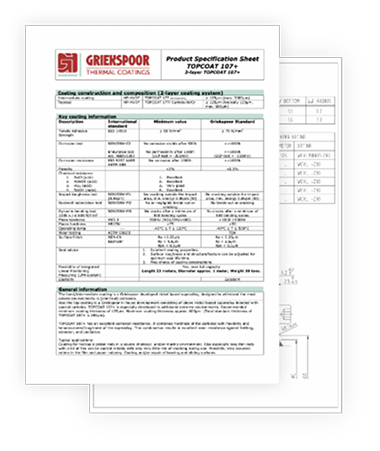
Griekspoor’s TOPCOAT 107 and TOPCOAT107+ specifically, rather than the coating line in general, is documented at 950 to 1,400 HV with a dynamic bending strength of 600 N/mm², tested through salt spray testing, electrochemical porosity testing, and polarisation curves in an in-house laboratory, the same kind of testing regime a component specifier would expect from any coating claiming these numbers. Other coatings in the range carry their own documented figures, available in full technical detail on their individual product pages rather than repeated here.
Fatigue life describes how a material responds not to a single load, but to the same load applied over andover again, which is exactly the kind of stress a coated component sees in realservice, a hydraulic rod extending and retracting thousands of times, or a shaft rotating continuously for years. A coating with a high dynamic bending strength resists the microscopic crack growth that repeated flexing would otherwise cause, which is a large part of why the figure is tested and published rather than inferred from static hardness alone.
None of this means hard chrome plating no longer has a place, and it’s worth saying so plainly rather than overselling the alternative.
“If a part just sits indoors at room temperature and doesn’t see much wear or water, chrome is still a perfectly fine coating, there’s no need to over-engineer that. But if you need the same low-friction, sliding behaviour chrome is known for, our CCR (chrome-carbide coating) and CCR+ are the closest match. If wear and corrosion resistance matter more, tungsten carbide is the better choice.”
Mario van Helmond, CEO Griekspoor Thermal Coatings
That’s a useful rule of thumb for any component specifier working through this decision: match the coating to the operating environment and the property that actually matters most, rather than defaulting to which ever coating sounds most advanced. Being upfront about these boundaries is part of what makes the comparison credible in the first place, a coating that claims to outperform chrome in every scenario invites more scepticism than trust. What that means in practice is covered from two angles elsewhere in this series, on Replacing hard chrome plating on hydraulic cylinders and piston rods and on Hard chrome plating replacementin marine and offshore equipment.
neem contact met ons op
Request Quotation
Vul het formulier in om een offerte aan te vragen
Offerte aanvragen